The never-ending peak season
August 18, 2026

With seasonal discounts, special events and the continued growth of online retail, what was once a clearly defined peak season has evolved into an almost year-round period of high demand.
The summer sales are already under way and, although the FIFA World Cup has ended, its commercial impact continues. On August 4, Adidas launched Spain's updated national team shirt featuring two stars to celebrate the country's two World Cup titles.
The warehouse reality: constant pressure & high stakes
These happenings mean more pressure, more orders and faster deliveries, all while warehouses are preparing for the back-to-school season. The US National Retail Federation (NRF) predicts that for this event, spending will reach an all-time high of over $146 billion, “making it the second-largest U.S. consumer spending event behind the winter holidays”.
Then of course, the Q4 holiday wave brings shopping spikes like Halloween, Black Friday and Christmas. The pace rarely slows, as any warehouse manager or member of the warehouse floor team knows. Maintaining high operational velocity requires real-time visibility and the ability to make fast, informed decisions.
Events such as the World Cup, or products that go viral overnight on social media, test a warehouse's ability to respond quickly to sudden demand shifts. Meanwhile, more predictable calendar milestones, such as Thanksgiving, place sustained pressure on physical capacity, forecasting accuracy, storage density and overall warehouse health.
In this context, a perfect alignment between the data that teams have, and the reality on the ground becomes one of the most important competitive assets a warehouse can have. Even with 90% accuracy, a mistake - for example not being able to find a product or the product being damaged - can be worth thousands of dollars, not to mention the potential fines from customers and the dissatisfaction of buyers.
This never-ending peak season that culminates with the yearly audits and all the additional effort that come with, turns any blind spot into a real operational and financial risk. Which is why a new approach is needed, one that combines autonomous robots with actionable intelligence and AI insights.

Dexory: autonomous intelligence for peak readiness
Real-time visibility is the first - and one of the most important - steps. Knowing exactly what’s in stock and where it is in the warehouse can make the difference between costly overstock or wasted products (the case for pharma goods or similar sensitive ones with a short lifespan) and a healthy cash flow.
Replacing manual counts with Dexory’s autonomous robots means that warehouses can now scan the facility daily, reaching past the front pallet, at speeds up to 10,000 items per hour. This gathers critical operational insights at high granularity. Beyond tracking available stock levels, advanced computer vision and AI capture additional metrics essential for storage health and compliance.
All these insights flow into an intelligent warehouse platform, DexoryView, that gives warehouse managers the real-time visibility they need to run operations with confidence, not just a count of what's on the shelves.
Here, they can find exactly what's where and how much of it (DexoryView can also integrate with the WMS for this), but the platform goes much further: it identifies misplaced or damaged items, flags fall risks and other non-compliance issues, tracks rented pallets, and lets multi-tenant 3PLs filter by client.
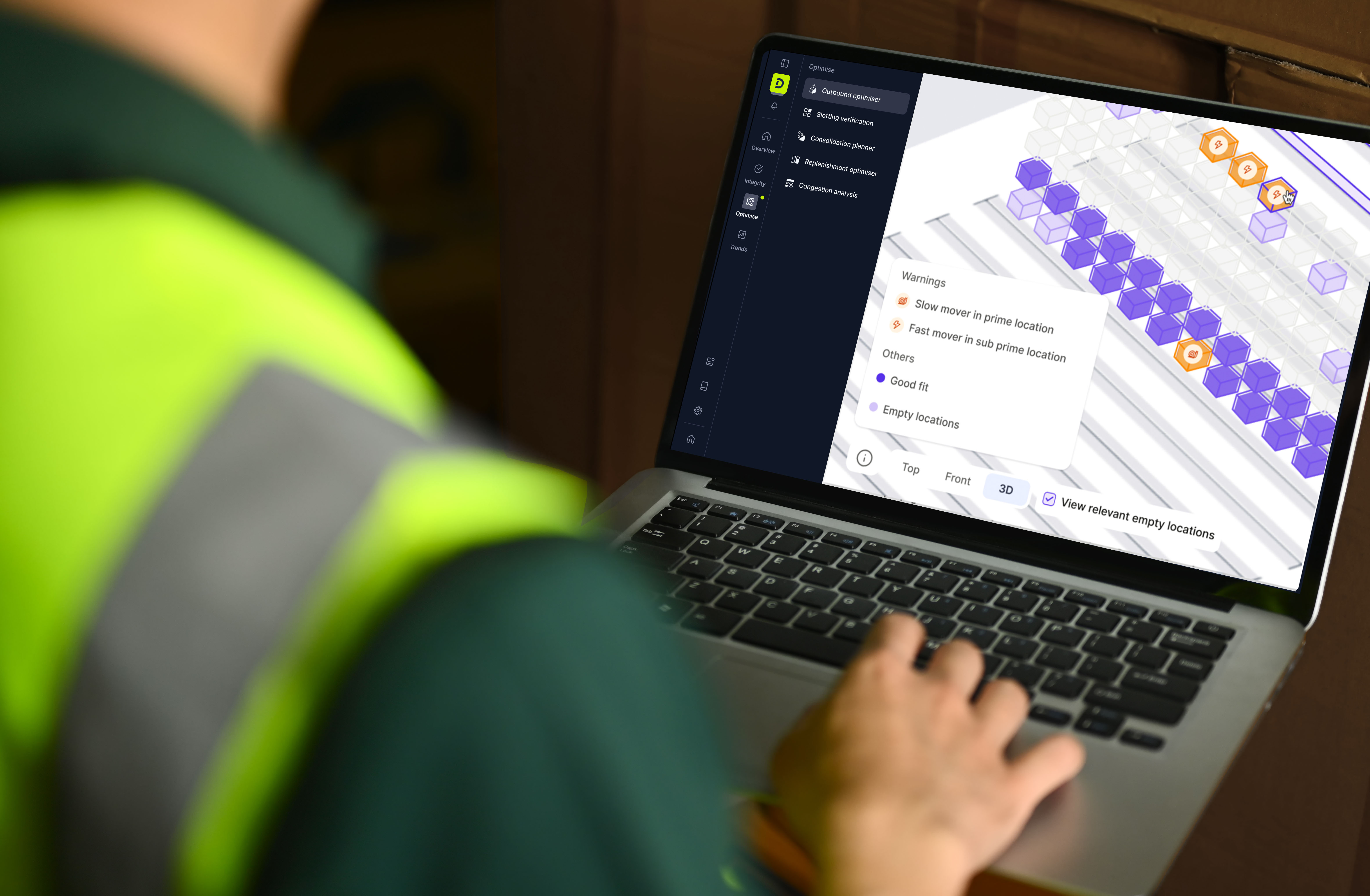
Also, DexoryView enables optimization and efficiency. Simply put, the Optimization module allows for better space planning, helps identify consolidation opportunities and reduce travel times, provides recommendations for smarter slotting and faster picking, and analyses stock movement patterns.
DexoryView Adapt closes the gap between knowing and acting, helping people with what they need to do next. Basically, the AI-enhanced system trains on people’s actions and operations and can then prioritize tasks and give answers to questions like: “how many locations are occupied by stock that hasn’t moved in 90 days?”.
It’s important to mention that Dexory is a solution that’s easily scalable across multiple locations, which unifies how data is managed across all of an operator’s warehouses and facilitates intelligence transfers between units.
Last but not least, Dexory is certified with SOC 1, SOC 2 Type I, and ISO 27001, meaning that the data we produce is secure, reliable, and compliant, so the solution can be used as an auditing tool in itself.
Building resilience for the always-on supply chain
Peak season is no longer confined to a single Q4 surge. Global events scheduled or ad hoc impact warehouses regardless of how prepared or not they are to meet these requirements.
Demand shifts can happen overnight - see, for example, the case of the Stanley Tumbler and the viral TikTok video that got +90 million views, or the over 100 million Labubu Dolls sold last year, a product that became extremely popular thanks to influencer endorsement.
Warehouses that rely on static inventory records, periodic audits and manual processes risk misallocating stock, overworking their staff and missing fulfillment windows.
By combining autonomous robotics with a real-time, AI-powered warehouse intelligence platform, Dexory's Physical AI solution enables supply chain leaders to transform peak season volatility into a predictable, automated operating model while improving readiness for annual audits.
Learn more about Dexory here.