From visibility to intelligence to action: The next chapter for Dexory
October 14, 2026

Six months after launching DexoryView Adapt (‘Adapt’), our customers are showing us how AI and physical intelligence are changing warehouse operations - and where the industry is heading next.
When we started Dexory, we set out to solve a fundamental problem in logistics: the gap between what warehouse systems believed was happening and what was physically taking place on the floor.
We pioneered autonomous robots that create continuously updated, high-fidelity digital twins of warehouses, giving operators visibility that simply hadn't existed before.
But visibility was always the starting point, not the destination.
Knowing what's happening is valuable. Knowing what to do about it, being able to act, and understanding whether that action worked is transformational.
That belief has shaped our evolution from visibility to intelligence, optimisation and, increasingly, orchestration.
And six months after launching Adapt, we're seeing just how significant that shift is.
The next leap in logistics is data driven autonomous action.
Warehouses have more systems, automation and siloed data than ever before. Yet connecting information, understanding what it means and deciding what to do remains surprisingly manual and near impossible to unify across multiple facilities.
An inventory discrepancy appears. Someone checks the WMS. Someone else investigates the physical location. Reports are compared, spreadsheets exported, and teams work backwards to understand what happened.
By then, the warehouse had already changed.
The next generation of logistics technology will work differently.
It won't just record what happened or show what's happening. It will continuously understand the operation, determine what should happen next, help execute those decisions and learn from the results.
What the first six months of Adapt has taught us
When we launched Adapt in April, our ambition was to combine continuously captured physical reality with operational systems, historical data, warehouse processes and deep logistics knowledge - and make that intelligence accessible to everyone running operations.
Instead of knowing which report to open or which system contains the answer, users can simply describe the problem:
- Why are inventory errors increasing in this area?
- Which products should we move closer to dispatch?
- What hasn't moved in the last week, month or year, and how much space is it consuming?
- What should my team prioritise today for maximum OTIF or minimum pick travel?
At Neele-Vat, users told us they learned more about their operations in two weeks with Adapt than in the previous six months.
At DCL Logistics, teams found that conversations about missing inventory, barcode discrepancies and location histories were more useful than navigating multiple reports and filters.
But what's most interesting isn't what customers are asking. It's what they're asking Adapt to do - what action to take.
Over 70% of Adapt usage now goes beyond lookup, data crunching or monitoring into diagnosis, recommendations, optimisation, automation and action.
Customers aren't asking where their inventory is anymore. They're asking where it should be to improve picking efficiency. Or how to organize for maximum space availability?
They're not just identifying errors. They're investigating why they happen, which matters most and what to fix first. What is the low hanging fruit, minimum effort, maximum impact, ultimate efficiency.
They're not measuring available space from DexoryView. They're looking for ways to consolidate inventory, release capacity and accommodate new and diverse business. They can run products.
That distinction represents a fundamental evolution. This democratises access to a level of logistics intelligence that is not possible outside Adapt.
What we're seeing isn't a simplistic transformation, dashboards becoming chat or voice interfaces.
It's questions and enquiries transforming into operational workflows.
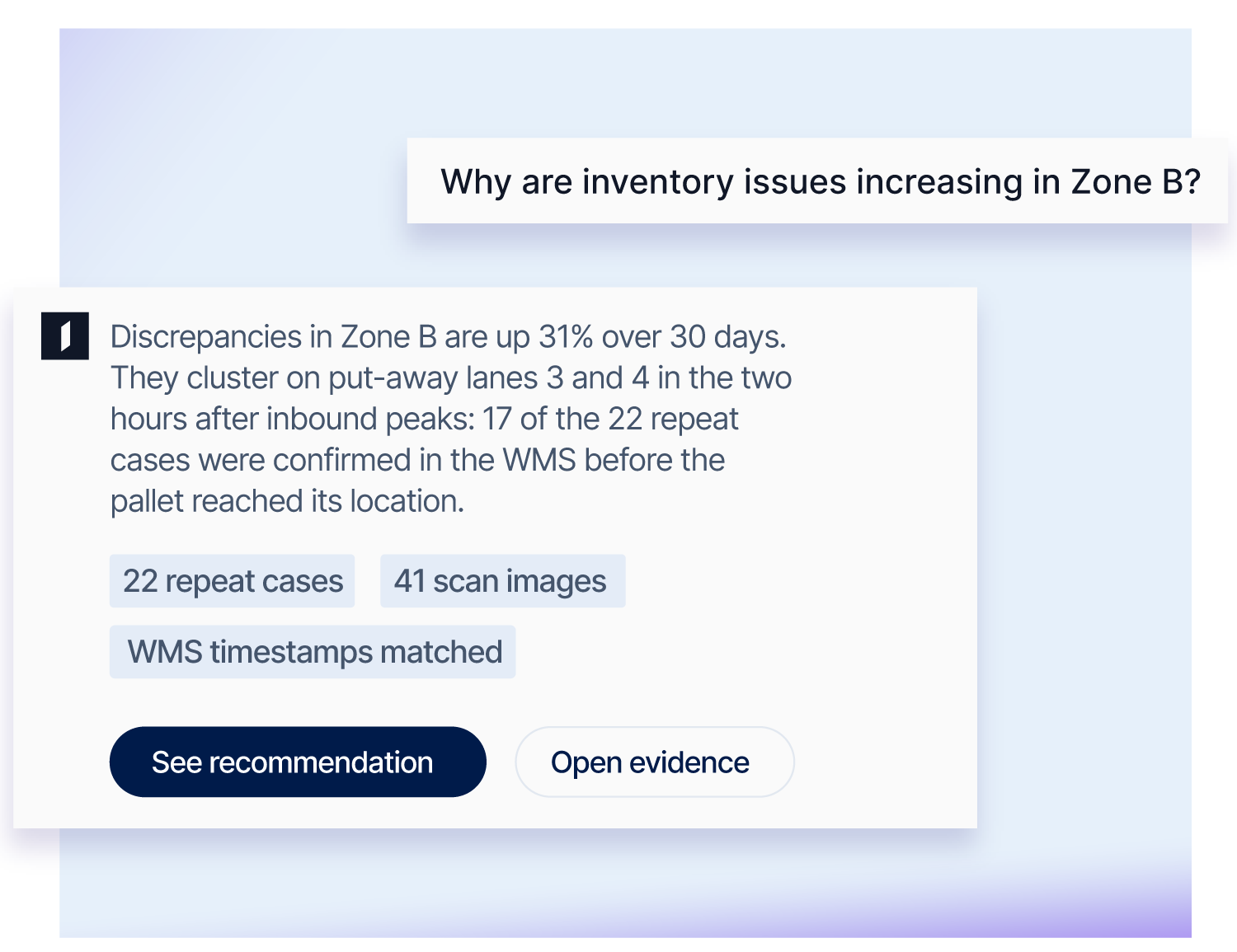
From answers to operational work
Some of the most valuable Adapt use cases are not about reporting. They're about improving productivity, space, inventory accuracy, labour efficiency and service levels.
With intelligent SKU slotting, Adapt combines movement histories, velocity, pick patterns and physical constraints to recommend better inventory locations.
With root-cause analysis, it connects physical observations, images, historical patterns and system records to explain recurring problems and recommend corrective action.
In pharmaceutical logistics, we're already seeing Adapt save hours of daily analysis by identifying the products and customers requiring attention in minutes.
The impact extends beyond analysis time. Better slotting reduces unnecessary movements and travel. Earlier identification of inventory issues can protect service levels. Smarter consolidation can release capacity without additional real estate. And proactive prioritisation helps teams focus resources where they have the greatest impact.
This is how intelligence translates into operational and financial performance.
And the experience is evolving beyond responding to questions.
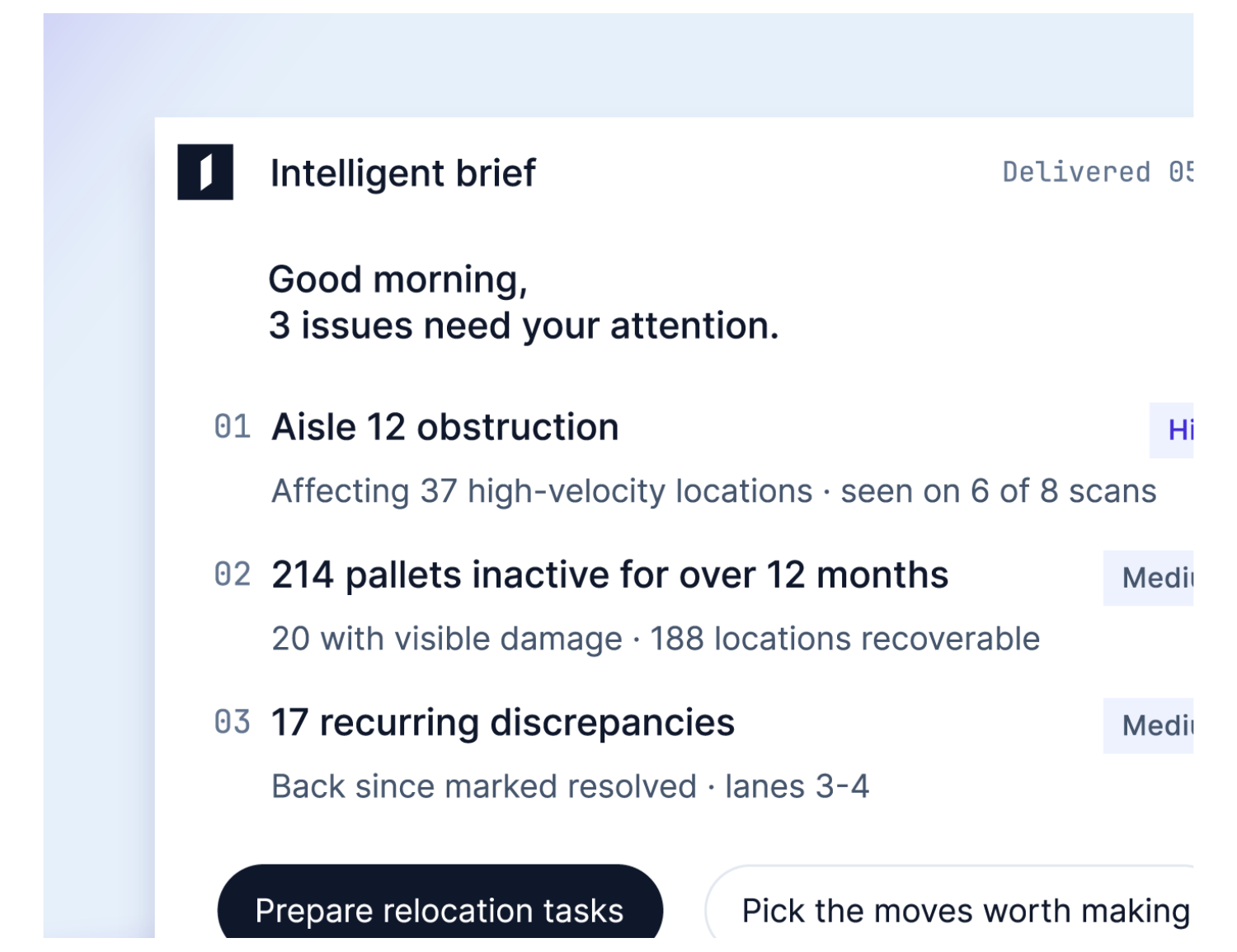
With On-Demand capabilities, teams investigate problems, analyse scenarios and optimise decisions. With Intelligent Briefs, Adapt proactively surfaces the priorities that matter to each person, from inventory discrepancies to capacity constraints and service risks.
This changes the role technology plays inside an operation. Rather than being a tool that teams consult periodically, Briefs become part of daily workflows - supporting decisions, prioritising actions and improving performance.
The workflow becomes:
Identify the issue → Understand the cause → Recommend the action → Assign the work → Verify the outcome.
That final step is critical. Because unlike AI systems operating purely on software data, Dexory can independently observe what physically happens afterwards.
Why our autonomous robots are foundational to Physical AI
There's a temptation to assume that as AI becomes more powerful, the underlying technology becomes less important.
We know the opposite is true.
The more intelligent and autonomous warehouses become, the more important it is that decisions are grounded in physical reality.
Warehouse systems tell us what should be happening. Our robots capture what is actually happening:
Where inventory physically sits. Whether locations are occupied or obstructed. How space is utilised. How the warehouse changes over time.
Across our deployments, we've captured data from more than 1.5 billion pallets and 75,000 warehouse operational days.
This proprietary dataset is more than a source of visibility. It's the foundation for Physical AI that can understand real warehouse operations and learn from their outcomes.
Every warehouse we observe, every operational pattern we identify and every outcome we verify contributes to a deeper understanding of how logistics operations function.
This creates a compounding advantage: the more we observe, the more we can understand, and the better positioned our intelligence becomes to recommend and optimise what happens next.
If Adapt recommends moving inventory or clearing an obstruction, our robots can subsequently verify whether the physical change occurred, creating the foundation for intelligence that learns from real-world outcomes.
Our robots aren't separate from our AI strategy. They're what makes our approach to Physical AI fundamentally different.
Beyond the digital twin: Towards orchestration
A live digital twin shows the warehouse as it is.
But intelligent decisions require more: understanding inventory movements, orders, people, equipment, workflows, operating rules and how they relate to one another.
That's why we're building the Logistics Operating Graph, connecting Dexory's physical ground truth with enterprise systems, operational knowledge, historical context and verified outcomes.
The digital twin captures reality. The Logistics Operating Graph connects that reality to decisions and actions across the world.
And Adapt is evolving into the intelligence layer that can turn those decisions into operational workflows.
Imagine a system that identifies inefficient inventory placement, recommends a better configuration, coordinates the necessary work and verifies the result - all backed with data and clear targets and KPIs.
We're already operating alongside picking robots, autonomous forklifts and other automated systems. Our data informs their operation through warehouse management systems today, while more direct integrations open opportunities for intelligent coordination.
This is the progression from visibility to intelligence to orchestration.
The next chapter: the autonomous warehouse
For years, warehouse automation has focused on making individual tasks autonomous - moving goods, picking orders and transporting inventory.
But …automating individual tasks doesn't make the warehouse itself autonomous.
True warehouse autonomy requires intelligence that understands the entire operation, the wider market context, coordinates decisions across systems and resources, and continuously adapts to changing conditions.
We believe this is the future of logistics: an operation that understands its own state, anticipates problems, determines what needs to change, coordinates resources and learns from the results.
Our robots provide physical understanding. The Logistics Operating Graph connects that reality with operational context. And Adapt is evolving into the intelligence and orchestration layer that turns understanding into action.
Human judgement remains essential. But increasingly, intelligent systems will take on routine analysis, prioritisation and coordination, allowing people to focus on higher-value decisions.
And while the warehouse is where we've started, the opportunity to connect physical reality, operational intelligence and coordinated action extends across the broader logistics network.
We started by helping warehouses see what was happening.
Then we helped them understand it.
Now we're building the technology to help them act, verify and continuously improve.
From visibility to intelligence to orchestration.
From warehouses that simply execute instructions to warehouses that can continuously adapt.
That's the future of the autonomous warehouse.
And that's what we're building at Dexory.
Andrei Danescu
Co-founder & CEO, Dexory